
National Flag
 The first national emblem is the National Flag. Created by General Manuel Belgrano on February 27, 1812, it was consecrated with the same colors "light blue and white" by the Congress of Tucumán on July 20, 1816, and ratified by that same body in Buenos Aires on February 25, 1818.
In order to honor the National Flag, Congress enacted a law on June 8, 1938, designating June 20—the anniversary of the death of its creator—as Flag Day and declaring it a national public holiday.
The Official Flag of the Nation consists of three horizontal bands: two light blue bands and one white band in the center, within which is depicted the Sun as represented on the gold coin of eight escudos and the silver coin of eight reales, engraved on the first Argentine coinage. The color of the Sun is gold yellow.
National Cockade
 As the result of a spontaneous initiative, in May 1810 the colors now recognized as the national colors began to be used in the National Cockade. Its use was officially recognized on February 18, 1812, at the request of the Triumvirate.
Feliciano Antonio Chiclana, Manuel de Sarratea, Juan José Paso, and Bernardino Rivadavia (as Secretary) forwarded to the Chief of the General Staff the text by which the use of the National Cockade of the United Provinces of the Río de la Plata was resolved and recognized, declaring it to be “that of two colors, white and light blue, and abolishing the red one by which they had previously been distinguished. This is hereby communicated to Your Honor for the appropriate purposes arising from this resolution.”
National Coat of Arms
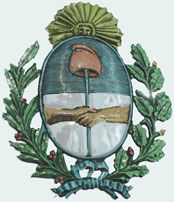 The Argentine Coat of Arms is a faithful reproduction of the seal used by the Sovereign General Constituent Assembly of the United Provinces of the Río de la Plata, as ordered by that Assembly on March 12, 1813.
Until the establishment of the General Constituent Assembly on January 31, 1813, there was no official seal for the enactment of governmental acts. Royal arms were used instead and were affixed to official documents during the viceregal period.
In response to this need, the Assembly began to use the seal that today constitutes the National Coat of Arms.
As evidence of this, two certificates of citizenship issued by the Assembly on February 22, 1813, have been preserved. These documents bear the Coat of Arms stamped in sealing wax: one is held at the National Historical Museum and was issued in favor of Don Antonio Olavarría; it is signed by the President of the Assembly, General Carlos María de Alvear, and by the Secretary, Don Hipólito Vieytes.